

How Does the New 1099-K Reporting Rule Work in 2026
Quick Answer Box
For the 12 months of the 2026 tax year, the IRS is enforcing the standard 1099-K reporting limit of $5,000. Third Party Settlement Organizations (TPSOs) – including Venmo, PayPal, Stripe, and eBay -have to problem Form 1099-K to any user whose gross business payments are $5,000. Remember not to do full business. Individual peer-to-peer transfers continue Completely exempt from reporting.
Key Takeaways
- 2026 Floor: The reporting floor is set strictly at $5,000, completely removing the legacy 200 transaction volumes metric.
- Gross Gross Income: Form 1099-K reflects raw processing volume before factoring in platform deductions, card expenses, processing fees, or returns.
- No structural tax changes: The rule updates how facts are sent to the IRS; Now it doesn’t levy a new tax on fair contractor sales.
- Personal transfers preserved: Splitting application bills, sharing dinner exams, or delivering gifts to your family is completely exempt and no longer generates paperwork.
- The Zelle Clearing Exemption: Zelle strategizes digital clearing at a bank-to-financial institution as opposed to a card settlement setup, meaning it’s miles and miles free of Form 1099-K requirements.
What is the Official IRS 1099-K Threshold for 2026?
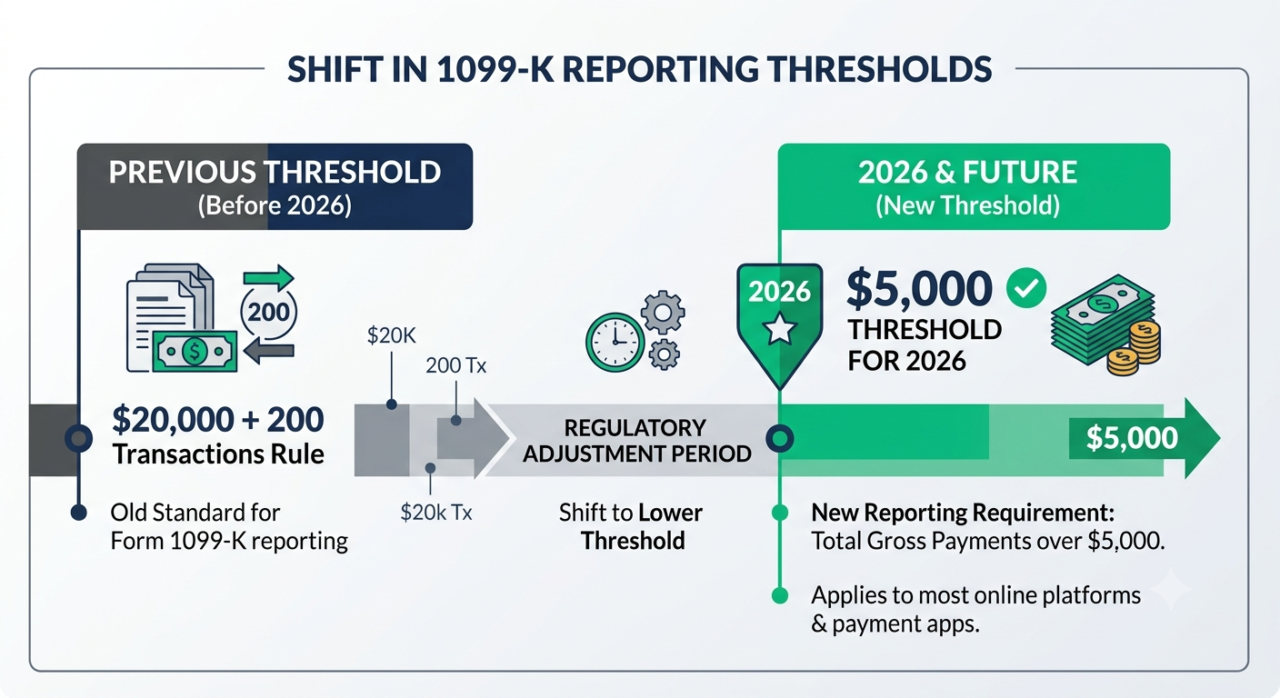
1099-K Reporting Threshold
As of the 2026 tax year, the Internal Revenue Service enforces an official 1099-K information reporting threshold of $5,000. Under this unified regulatory framework, any Third-Party Settlement Organization (TPSO) conducting business within the United States is statutorily required to generate and dispatch Form 1099-K both to the taxpayer and directly to the IRS. This reporting is triggered the moment an account’s gross commercial payment transactions cross the $5,000 mark inside the calendar year, making the historical transaction volume rules completely obsolete.
This $5,000 reporting boundary marks the completion of an extended administrative phase-in managed by the U.S. Department of the Treasury. Originally, the American Rescue Plan Act aimed to lower the legacy reporting floor of $20,000 and 200 transactions all the way down to a strict $600 limit. To ease the massive compliance strain on payment applications and prevent millions of erroneous tax forms from flooding everyday Americans, the IRS exercised its administrative authority under Internal Revenue Code Section 6050W to execute a step-by-step rollout, establishing this permanent $5,000 transition ceiling for 2026.
How Does the 1099-K Differ From a 1099-NEC Form?
Independent contractors, online marketplace sellers, and side hustlers must understand that Form 1099-K tracks specific payment mechanisms, whereas Form 1099-NEC tracks corporate payment entities. Misunderstanding this operational boundary is one of the most common reasons self-employed individuals overpay their taxes or trigger automated audits.
| Strategic Metric | Form 1099-K | Form 1099-NEC |
|---|---|---|
| Primary Tracking Focus | Payments cleared via credit cards, debit cards, and third-party apps. | Direct business-to-business payments for professional services rendered. |
| 2026 Trigger Floor | Gross processing exceeding $5,000 within the year. | Total compensation reaching $600 or more. |
| Volume Requirements | None (Transaction count is completely irrelevant for 2026). | None. |
| Primary Issuing Entities | PayPal, Venmo, Stripe, Square, eBay, Etsy, etc. | Corporate clients, small businesses, and general contractors. |
| Adjustments Included | Reports absolute gross volume; zero initial cuts for platform fees or returns. | Reports net compensation delivered directly to the freelance entity. |
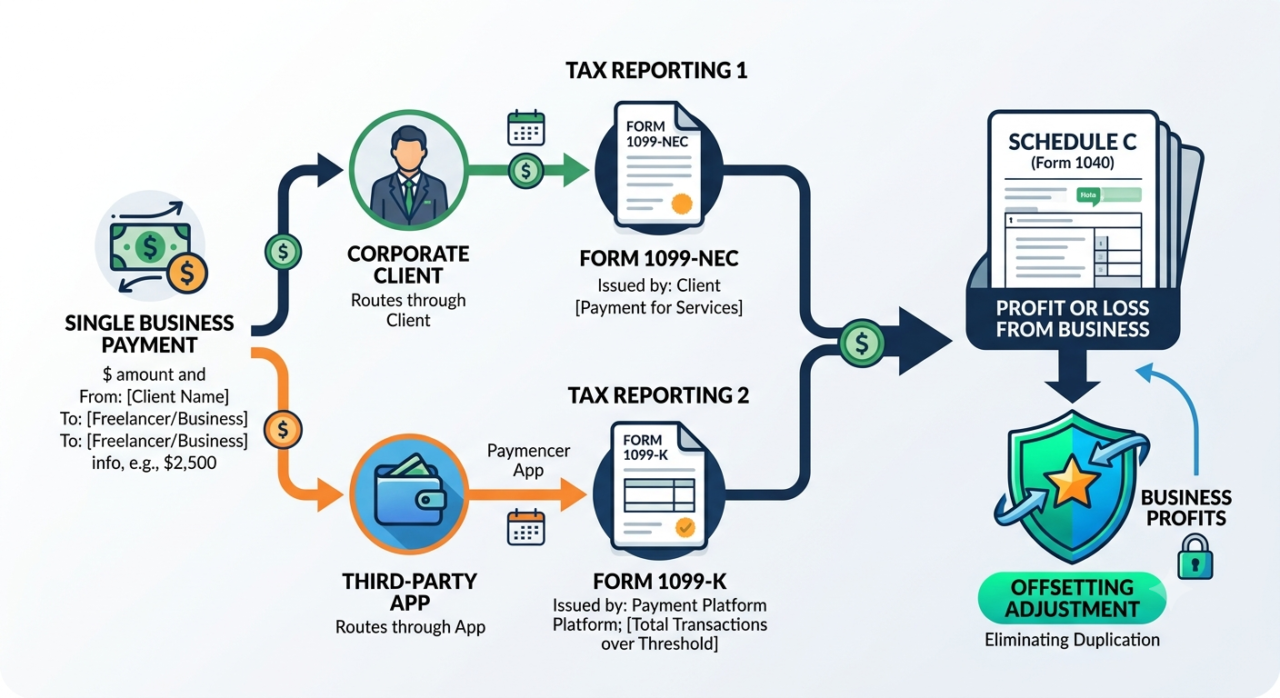
This overlapping structural design creates a significant tax trap: accidental revenue double reporting. For example, if a corporate client engages an independent freelancer for a $6,500 contract and clears that invoice using PayPal or an integrated credit card portal, the cash is captured twice. The corporate client reports a $6,500 outlay on Form 1099-NEC, while PayPal reports that identical $6,500 inflow on Form 1099-K.
To prevent the IRS’s automated systems from assuming you earned $13,000 instead of $6,500, you must explicitly match your reported gross receipts on Schedule C, Form 1040. You do this by entering the total amount, then deducting the duplicate reporting with a clearly labeled line-item adjustment under “Other Expenses.”
Do I Have to Pay Taxes on Personal Payments and Peer-to-Peer Transfers?
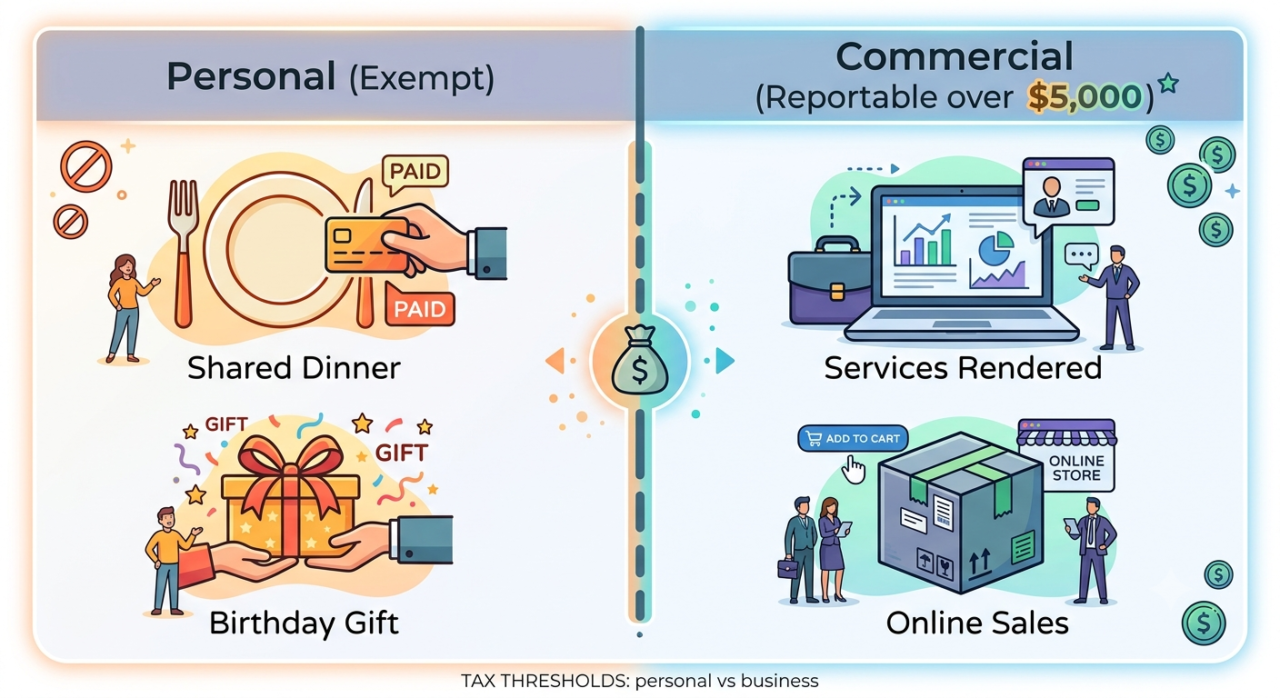
P2P Separation Visual
The short answer is no. The 1099-K reporting rule applies strictly to commercial transactions involving the sale of goods or the performance of professional services. Personal transfers are completely exempt from income tax and informational filing mandates.
The internal accounting mechanisms of major payment processors separate personal peer topeer transfers from business ones using user-selected tags. Standard personal activities such as reimbursing a roommate for rent, splitting a restaurant dinner check, or sending cash gifts to family members do not fall under commercial definitions and will not trigger a Form 1099-K, provided you do not mistakenly label them as commercial goods or services payments.
The Zelle Network Regulatory Exemption
A common point of confusion among self-employed individuals is whether bank-to-bank transfers trigger tax reporting. Zelle operates through a clear regulatory exception. Because it functions as a direct settlement clearinghouse between member financial institutions rather than acting as an independent third-party intermediary, Zelle does not qualify as a TPSO under IRS guidelines. As a result, Zelle does not issue Form 1099-K under any circumstances. However, this does not make commercial revenue received via Zelle tax-free. Independent contractors are still legally required to track, declare, and pay self-employment taxes on all business income, regardless of whether a platform generates an information return.
How Do I Calculate and Reconcile My 1099-K Income to Avoid Double Taxation?
Because Form 1099-K reports the absolute gross volume of your transactions, your stated numbers will almost always be higher than the actual cash that hits your bank account. To protect your margins and safeguard your path to early retirement, you must run a precise reconciliation process.
How Does the New 1099-K Reporting Rule Work in 2026
Scenario A: The Rideshare and Side-Hustle Professional
Consider Maria, a full-time gig worker who provides rideshare services and runs an AI prompt -engineering consulting service. Throughout 2026, her processing activity breaks down as follows:
- Gross fares collected via platform apps: $24,500
- Platform passenger ride fees deducted before payout: $5,200
- Consulting fees collected through a commercial payment profile: $8,800
- Payment app merchant processing fees: $310
When January 2027 arrives, Maria receives two separate 1099-K forms totaling $33,300 ($24,500 + $8,800). If she simply copies that total onto her tax return without making proper adjustments, she will end up overpaying her taxes by thousands of dollars. To fix this, Maria calculates her true taxable profit using the standard self-employment formula:
Net Self-Employment Income = Gross 1099-K Receipts − Platform Fees − Processing Costs −
Operating Expenses
Net Self-Employment Income = $33,300 − $5,200 − $310 − $4,500 = $23,290
Maria reports her full gross income of $33,300 on Line 1 of Schedule C. She then lists her platform and transaction processing fees ($5,510 total) alongside her other business deductions ($4,500) within Part II of Schedule C. This reduces her net taxable income to $23,290, saving her from paying income and self-employment taxes on $10,010 of non-existent profit.
Scenario B: Selling Used Personal Items at a Loss
Next, let’s look at Marcus, a blue-collar manufacturing specialist pursuing the FIRE movement. In 2026, Marcus cleans out his garage and sells his used personal truck parts on eBay for a total of $5,400. Because this crosses the $5,000 threshold, eBay sends him a Form 1099-K. However, Marcus originally bought these parts years ago for $9,000. Because he sold these personal assets at a net loss, he does not owe any income tax on this money.
To clear this up and keep the IRS from flagging his return, Marcus reconciles the transaction across Schedule 1 (Form 1040) using these balanced entries:
Schedule 1, Part I, Line 8z (Other Income): Marcus inputs the full $5,400 from his Form 1099-K to mirror the platform’s reporting.
Schedule 1, Part II, Line 24z (Other Adjustments): Marcus enters an equal offsetting adjustment of $5,400, explicitly labeling it “Form 1099-K Received for Sale of Personal Items at a Loss.”
By keeping the net impact on his Adjusted Gross Income (AGI) at exactly $0, Marcus avoids tax liabilities while showing the IRS that the reported 1099-K was fully reconciled.
What Steps Should I Take If My Form 1099-K Is Wrong?
If you receive an incorrect Form 1099-K whether due to a platform system glitch, a mix-up between personal and business transfers, or duplicate reporting you need to act quickly to resolve the error.
- Download and Cross-Reference Your Records: Log into your payment platform and export your full transaction ledger for the 2026 calendar year. Isolate every transaction by date, recipient name, and payment type to locate the exact discrepancies causing the error.
- Request a Form Correction From the Platform: Contact the payment processor’s support team right away. Request a corrected Form 1099-K that shows the accurate commercial totals. Keep copies of all your support tickets and chats to protect your business records.
- Apply an Offsetting Line-Item Adjustment: If the platform fails to issue a corrected form before the tax filing deadline, you can fix the issue directly on your return. Report the full gross amount from the incorrect Form 1099-K on Schedule 1, Part I, Line 8z. Then, enter a matching correction on Schedule 1, Part II, Line 24z labeled “Incorrect Form 1099-K Entry Platform Documentation Error,” reducing the net tax impact to its proper level.
Conclusion
Navigating the changing landscape of IRS information-reporting rules can feel intimidating, but understanding the 2026 1099-K implementation gives you a clear financial edge. This rule change does not cost you more in taxes it simply demands greater precision in your bookkeeping. By keeping clean records, explicitly separating business revenue from personal cash flows, and tracking your processing costs, you protect your business margins from expensive double counting mistakes and audit triggers.
For those pursuing the FIRE movement or building long-term financial security through the gig economy, audit-proofing your independent income is essential for wealth preservation. When you accurately reconcile your gross revenues and minimize your taxable profit on Schedule C using legitimate business expenses, you directly free up cash flow. This capital can then be funneled directly into tax-advantaged accounts like a Solo 401(k) or a Roth IRA, turning tax compliance into a valuable engine for your long-term financial freedom.
FAQs
What is the official IRS 1099-K threshold for 2026?
For the 2026 tax year, the IRS 1099-K reporting threshold is $5,000. Third-party settlement organizations are required to issue a Form 1099-K to any user who receives more than $5,000 in gross payments for commercial goods or services, regardless of the total number of transactions.
Does Zelle report payments to the IRS via Form 1099-K?
No, Zelle does not report payments on Form 1099-K. Zelle operates as a bank-to-bank electronic funds transfer network rather than a Third-Party Settlement Organization, meaning it is exempt from 1099-K information-reporting rules.
Will I get a 1099-K if I sell personal items at a loss?
Yes, you will receive a Form 1099-K if your gross proceeds from selling personal items exceed $5,000 in 2026. Because personal items are generally sold for less than their original cost, this creates a non-deductible personal loss that does not generate taxable income once properly balanced on your return.
How do I avoid double-taxation if I get both a 1099-NEC and a 1099-K?
To avoid double-taxation, report the full gross receipts from your Form 1099-K on Line 1 of Schedule C. Then, list any duplicate income already accounted for on Form 1099-NEC within Part II of Schedule C under “Other Expenses,” with a clear explanation to remove the duplicate revenue.







2 thoughts on “How Does the New 1099-K Reporting Rule Work in 2026”