
A client rarely cares that you spent six hours wiring up an API. They care that leads stop falling through the cracks, estimates go out faster, and their team stops copying the same information between five different systems. AI Automation Consulting for Small Businesses: How to Price Your Work
That’s where your pricing opportunity comes from. But it’s also where people get trapped. If you quote based only on your build time, you’re turning valuable business improvement into basic commodity labor. If you promise massive savings without a real baseline, you’re gonna create a major trust and compliance problem between you and the client.
Quick Answer

Most SME AI automation tasks can be priced in tiers: a paid audit, a fixed fee implementation, and optionally available month-to-month support. Now, market observations show that audits range from $1,500.00 to $15,000.00, implementations range from $2,000.00 to $30,000.00+, and help holders range from $500.00 to $10,000.00 month to month. The appropriate quote depends on measurable value, threat, complexity, and general scope.
Key Takeaways
- Determine the value of the end result of the business described, not the “AI Transformation”.
- Use paid diagnostics when the underlying workflow is messy or unclear.
- Fixed cost painting is first class if you have a clear scope and a stable pull test.
- Holders should buy into energetic tracking, upgrades and response time, no longer lackluster availability.
- Calculate the return before providing a quote, and consistently disclose your assumptions.
- Clarify buyer information guidelines, account ownership, human assessment, and exchange orders.
- Separate cash for taxes, operating costs, coverage and retirement before treating revenue like private cash.
What does AI Automation Consulting actually involve?

What does AI Automation Consulting actually involve?
The AI automation consulting approach identifies repetitive workflows, picks and configures technology, integrates with current software, tests setups, trains customers, and establishes human oversight It’s certainly not just about writing motivations or turning on an original chatbot.
A common engagement process is mapping, tool selection, CRM integration, report extraction, lead routing, customer support triads, internal search gear, reporting, QA, and monitoring The more systems, record types and field cases you touch, the more work looks like engineering instead of small chat.
Here’s the key difference: Structured automation only runs facts known by routine steps. AI automation interprets messy inputs like texts, photos and emails. That second category wants things like additional testing and stricter guidelines for when a human needs to step in, so it has to be worth the extra.
What Does AI Automation Consulting Actually Include?

What Does AI Automation Consulting Actually Include?
AI automation consulting means identifying a repeatable workflow, picking and configuring technology, integrating it with existing software, testing the setup, training users, and maintaining human oversight. It’s definately not just writing prompts or turning on a basic chatbot.
A typical engagement includes process mapping, tool selection, CRM integrations, document extraction, lead routing, customer support triage, internal search tools, reporting, QA, and monitoring. The more systems, data types, and edge cases you touch, the more the work looks like engineering instead of a quick chat.
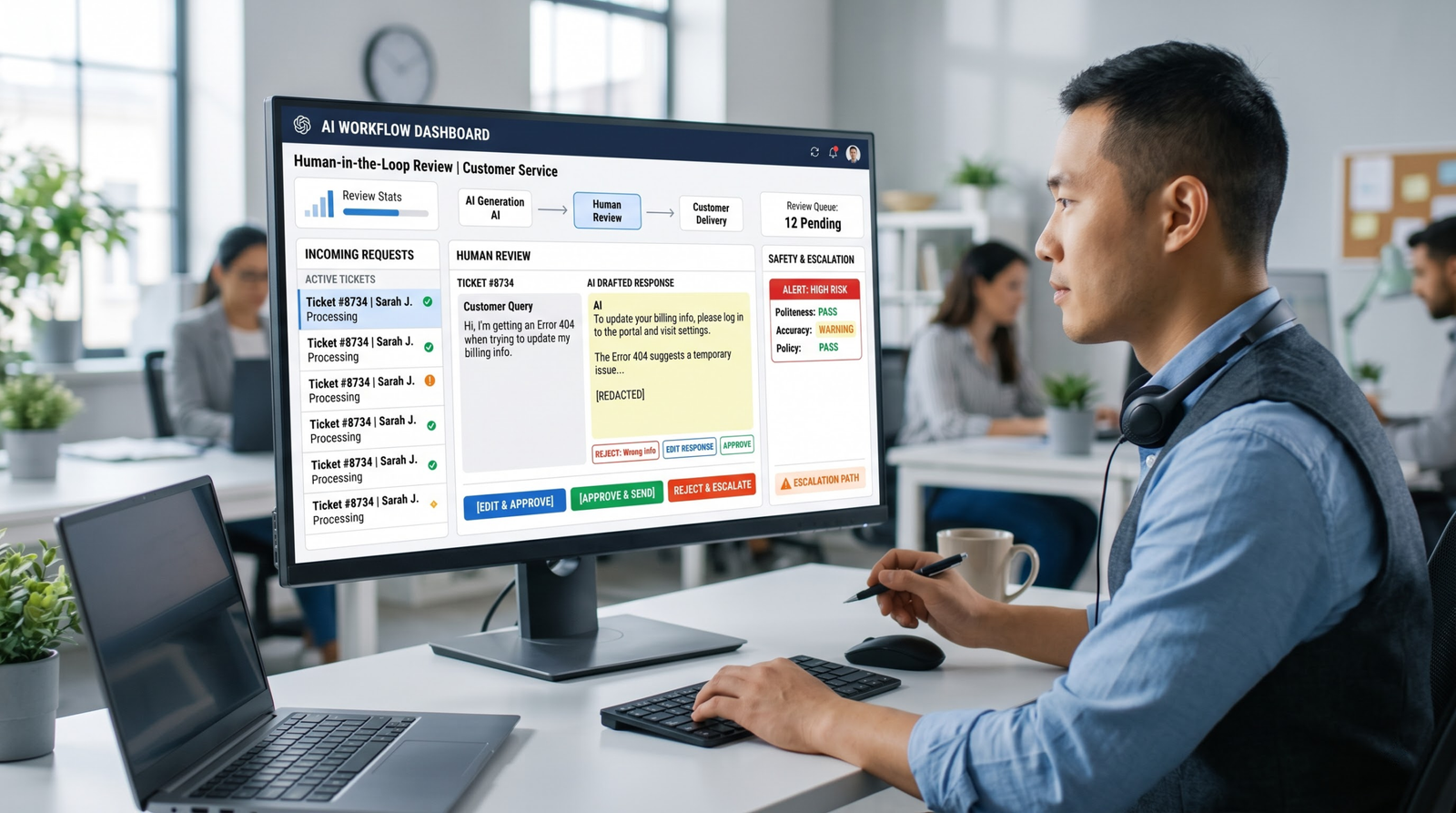
Here’s the main difference: structured automation just moves known information through fixed steps. AI automation interprets messy inputs like text, images, or emails. That second category needs way more testing and stricter rules for when a human needs to step in, so it should cost more. A basic lead form that creates a CRM file is easy creation. But a gadget that reads e-mail, identifies customer motives, drafts responses, evaluates business enterprise coverage, and sends out human eyes is over-risk management you charge more checking out and operational crisis as a result.
Read Also:- Are AI Tool Subscriptions Tax-Deductible? A 2026 Freelancer’s Guide
How Much Should You Charge?
A practical starting framework uses $1,500 to $15,000 for an audit, $2,000 to $30,000 or more for implementation, and $500 to $10,000 per month for ongoing support. These figures are just market observations from current consultant pricing pages, not official industry statistics.
| Engagement | Typical Scope | Price Band |
| Discovery session | One focused problem, 60 to 120 minutes | $250.00 to $750.00 |
| Workflow audit | Interviews, process map, prioritized roadmap | $1,500.00 to $5,000.00 |
| Full AI readiness assessment | Multiple workflows, systems, risk review | $5,000.00 to $15,000.00 |
| Simple implementation | One integration or structured workflow | $2,000.00 to $7,500.00 |
| AI-assisted workflow | Unstructured input, review, testing, docs | $7,500.00 to $20,000.00 |
| Multi-system build | CRM, support, documents, reporting, training | $15,000.00 to $30,000.00+ |
| Support retainer | Monitoring, fixes, small improvements | $500.00 to $3,000.00/month |
| Fractional partner | Strategy roadmap, build work, team enablement | $2,500.00 to $10,000.00+/month |
Don’t present this chart as a promise. It’s just a conversation starter. A $2,000.00 project is expensive if it saves almost nothing. A $12,000.00 project makes total sense if it removes a bottleneck and pays for itself within a year.
The real question isn’t “What do AI consultants charge?” It’s “What is this workflow worth, what could go wrong, and what level of delivery does the client actually need?”
How Do You Calculate a Defensible Price?
A solid quote starts with your delivery floor, checks the client’s value, and then adjusts for risk. You need all three. Value alone leads to aggressive quotes that lose deals, and hours alone will destroy your margin.

How Do You Calculate a Defensible Price?
Step 1: Calculate Your Delivery Floor
Delivery Floor Formula
Minimum project price = (estimated delivery hours × loaded hourly floor) + software/subcontractor costs + risk reserve
Let’s say you want to make $1,20,000 as an annual owner’s salary. You plan on 1,600 work hours, but the simplest 800 hours are billable after income, admin, teaching, and mentor. Your repayment land is $150 corresponding to the billable hour before software, taxes, or benefits.
The hard work area for a 24-hour project is $3,600. Add $250 to the software fee, plus $500 for the challenge combination, and your quote should not go below $4,350. If the value to the customer is a whole lot better, then quote above that land. If their spending is down, they’re probably bad healthy after all.
Step 2: Estimate Measurable Value
For labor capacity, use this formula:
Labor Value Formula
Annual labor value = hours saved per week × 52 × loaded hourly cost
If a system saves 8 hours a week and the employee doing that task costs $35.00 an hour, the annual saved capacity is $14,560.00. A $6,000.00 setup gives them a payback period of about 21.5 weeks.
For recovered sales opportunities, keep your math conservative:
Opportunity Value Formula
Annual opportunity value = added qualified opportunities × close rate × contribution margin
If automation brings in 10 additional qualified leads a month with a 20% close fee and a $600 margin corresponding to the patron, your anticipated fee is $14,400 over 12 months. Just don’t claim that entire machine precipitated unless you literally show it.
Step 3: Adjust for Risk and Complexity
Charge more when the work touches sensitive data, client-facing messaging, multiple tools, complex permissions, or buggy APIs. You can lower complexity by shrinking what’s included in version 1.0.
Here’s a good rule: if the client can’t point to the process owner, the main data source, or the common exception cases, you aren’t ready to give a fixed price. Sell them a diagnostic first.
Which Pricing Model Should You Choose?
Which Pricing Model Should You Choose?
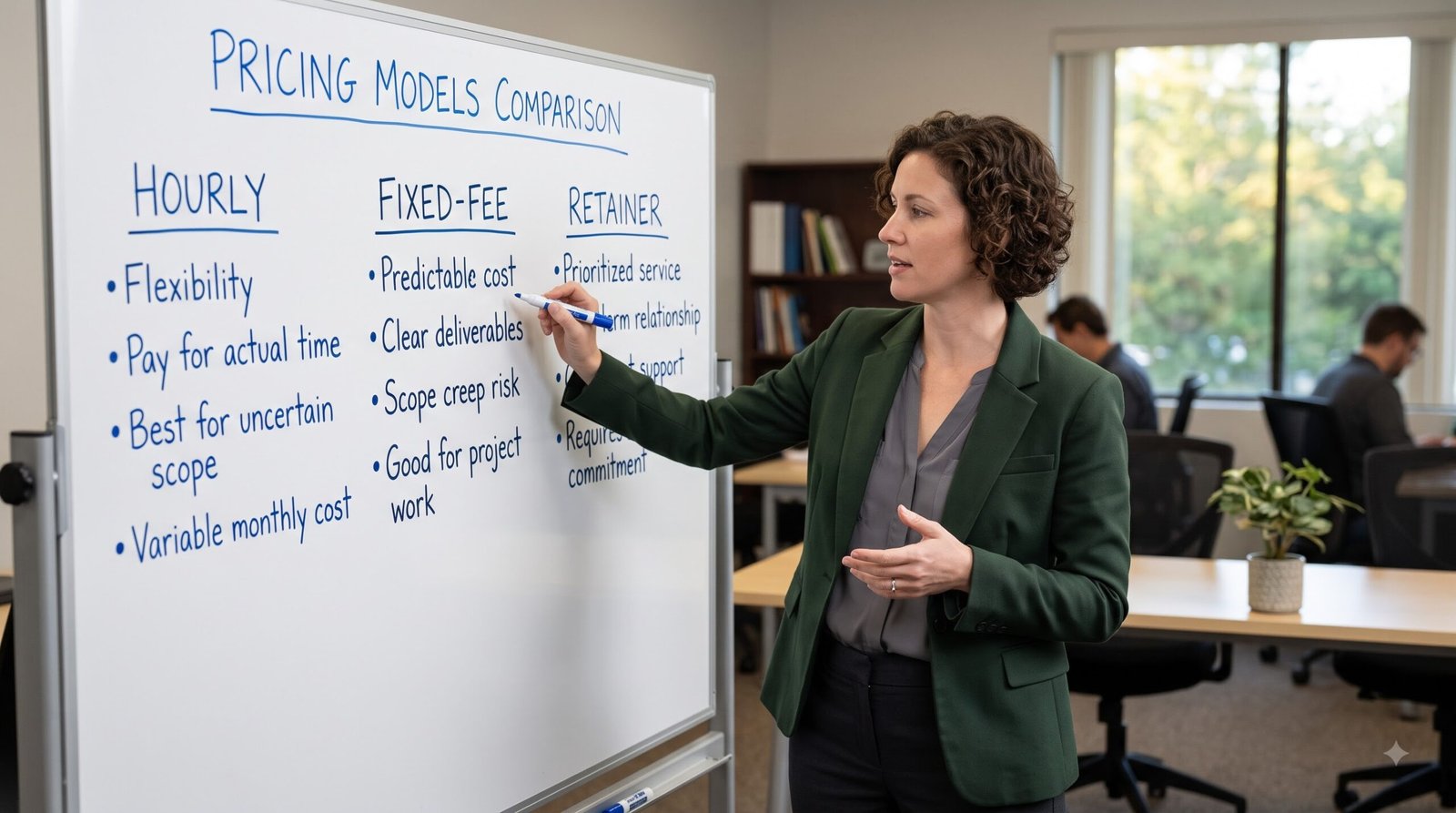
Use hourly rates for exploration, fixed fees for clear deliverables, retainers for maintenance, and performance pricing only when you control the variables. Hourly billing isn’t wrong, but relying on it for everything penalizes your efficiency.
| Model | Best Use | Main Benefit | Main Risk |
| Hourly | Exploration, advisory, unknown scope | Protects your time | Penalizes speed, causes fights over hours |
| Fixed fee | Clear workflow and acceptance criteria | Easy decision for buyer | You absorb scope creep |
| Retainer | Monitoring, tweaks, quick response | Predictable income | Turns into unpaid availability |
| Performance | Measurable results with shared control | Big upside potential | Hard to prove attribution |
| Hybrid | Most small-business engagements | Balances clarity and risk | Needs clean boundaries |
Hourly Pricing
Market fees across the cheap independent sites range up to hundreds of dollars per hour for senior devs. One values the simplest things when it is attached to quick and first class.
If you rate $150 per hour and it takes 30 hours, the buyer could pay $4,500. If you get faster and do the same pictures in 15 hours, hourly pricing cuts your sales in 1/2. That penalizes your boom. Save hourly fees for discovery or consulting work, then shift to routine pricing of constructions.
Fixed-Fee Projects
Fixed pricing is usually the cleanest setup for a single workflow. You just gotta define deliverables, exclusions, client tasks, acceptance rules, and how change orders work.
Here’s a sample package:
- Workflow map and baseline metrics
- One production automation
- Two connected software systems
- 10 test scenarios
- Human review step
- Written documentation and one training session
- 14 days of bug fixes
- Excludes new tools or software subscription fees
A package like this could be quoted at $6,000.00, $9,000.00, or $15,000.00 depending on complexity. The specific price matters less than whether the scope is actually testable.
Retainers
A retainer needs to outline specific work every month. “Ongoing AI support” isn’t a clear service. “Monitor one workflow, check error logs weekly, push two small tweaks, and reply within two business days” is a clear service.
A $1,500.00 monthly retainer generates $18,000.00 a year. If it takes 12 hours a month, your gross rate is $125.00 an hour. But if it secretly takes 25 hours ’cause the client keeps changing things, you’re losing money. Track your time for the first 90 days and adjust the contract if needed.
Read Also:- How to Track AI Side Hustle Income for Tax Season
How Should You Price Common Projects?
Cost projects based on workflow complexity and operational feasibility, not software program calls. A chatbot can be a simple FAQ device or a high-threat system linked to patron orders and payment records.
Lead routing and follow-up
Transferring lead data from web-size to CRM is straightforward. But if you upload fact enrichment, qualification good judgment, calendar hyperlinks, SMS indicators, and area routing, the scope increases rapidly.
Citation based on full path: consumption, validation, routing, compliance-up, exceptions, and reporting. An easy setup typically steps in from $3,500 to $7,500 if the structures have APIs on hand.
Inbox triage
Inbox automation solves a pesky hassle, but it also involves risk. An incorrect label or an awkward response can break a buyer’s courtship.
Start by sorting emails and drafting replies for human checking. Do not set automobile-send on the first day. Observation workflows and security assessments as part of the core work are valued.
Document Processing
Document workflows require additional value range for collecting samples, mapping fields, checking accuracy, and dealing with aspect instances.
Removing a bill number is remarkably simple. Building a device that approves regular payments is much more risky. Never value the second as much as the first.
Chatbots and Internal Assistants
A basic internal FAQ bot is easy to set up if the documentation is clean.
Pricing goes up when the bot has to pull from changing files, access account data, hand off conversations to staff, or meet specific uptime requirements.
Reporting and Operations Dashboards
Automating reports sounds simple until you realize the client’s underlying data is messy.
Price the data cleanup work, permissions, update schedules, and documentation. Building the dashboard visual is fast; fixing their data pipeline is where the actual time goes.
How Do You Prove ROI Without Making Wild Promises?

How Do You Prove ROI Without Making Wild Promises?
Use a clear baseline, conservative estimates, and a real testing period instead of guaranteeing crazy results. Promising fixed income or savings will destroy your reputation and could run into regulatory issues. The FTC has actively gone after companies making deceptive earnings claims around AI tools.
Payback Period Formula
Payback period (months) = total implementation cost ÷ net monthly benefit
Say a project costs $7,500.00. The workflow saves 6 hours a week at a loaded labor cost of $40.00 an hour, creating $1,039.00 in monthly saved capacity. Software costs $139.00 a month and maintenance runs $200.00. Your net monthly benefit is $700.00, which means payback takes about 10.7 months.
That’s a practical forecast, not a promise. Changes in team adoption, order volume, or software updates can shift the timeline. Put these assumptions in writing so everyone agrees on how success gets measured.
Examples for Your Knowledge

HVAC Business
Aurora’s HVAC Business
Aurora is a six-man or woman HVAC installer. Her technicians spend about 10 hours a week manually entering net forms and voicemail notes into their CRM. At a weighted price of $32.00 per hour, that wasted time takes a toll of $16,640.00 per year in kind.
A consultant sells her a $5,800.00 mission that masks workflow mapping, transcription management, CRM routing, evaluation lines, effort, and education. The running software program and monitoring runs $180.00 a month. If the new machine saves 7 hours per week, Internet’s month-to-month profit is $596.00, giving it a payback period of about 9.7 months.
The representative should not promise a loose $16,640.00 windfall. They should consider the nation that 10 hours is the baseline, 7 hours collected is the goal, and the primary month is the committed trial length.
Oliver’s Bookkeeping Practice
Oliver gets loads of receipts and customer questions via e-mail. He wants an AI assistant that reads every message, classifies files, and replies regularly. But jumping straight to full automation involves too much risk for the monetary corporation.
Instead, he buys a rating system for $4,500.00. It labels incoming email, extracts primary statistics, drafts response templates, and routes complex messages to Oliver. It in no way sends monetary advice or touches client books without reviewing it. The $750.00 monthly retainer covers log evaluation, set off updates, and ordinary maintenance.
This staged technique minimizes the risk of error and saves Oliver time. That’s solid advice, no longer a missed income opportunity.
What Should an AI Proposal Include?
What Should an AI Proposal Include?
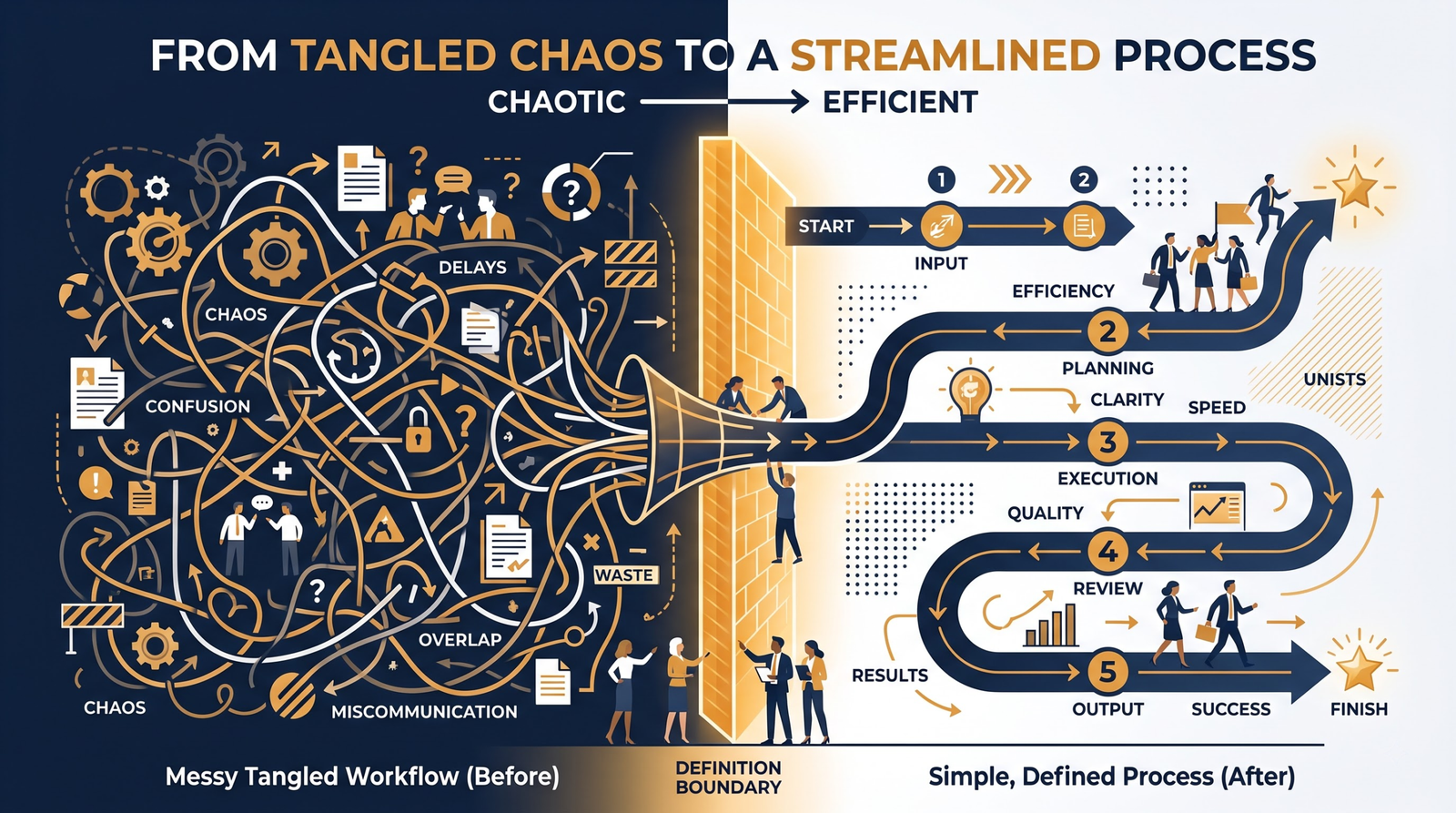
A good proposal converts a vague idea into a practical project plan. Make sure you cover these key areas:
1. The business problem and current baseline metrics
2. A clear, one-sentence project goal
3. A map of the workflow and software involved
4. Included deliverables
5. Exclusions and client responsibilities
6. Data security, privacy rules, and account ownership
7. Human review steps and exception handling
8. Testing plans and acceptance criteria
9. Project timeline and review milestones
10. Fixed fee, payment schedule, and software costs
11. Change order guidelines
12. Warranty, ongoing support, and response times
13. User training, documentation, and handoff rules
14. The performance measurement plan
Use milestone payments to protect your cash flow. For instance, ask for 40% upfront, 40% after testing a working prototype, and 20% upon final sign-off. On smaller builds, a simple 50/50 split works great. Tie acceptance to explicit deliverables rather than whether the client “likes” the final tool.
Pay extra attention to software accounts. Always set up production tools inside accounts owned directly by the client, using delegated access for your team. It makes handoffs smoother and avoids messy disputes later on.
What Taxes and Costs Should You Plan For?

What Taxes and Costs Should You Plan For?
Don’t treat client payments like pure profit. You gotta account for estimated taxes, self-employment taxes, software bills, insurance, and retirement savings. The IRS considers independent contractors and freelancers to be self-employed, which comes with quarterly tax requirements.
IRS Publication 505 and Form 1040-ES lay out the official guidelines for estimated payments. The IRS also updated bracket adjustments for 2026, setting standard deductions at $16,100.00 for single filers and $32,200.00 for joint filers. These figures give you a starting point, but they won’t tell you your exact tax bill.
Tax Reserve Example
If you collect $10,000.00 on a project and spend $1,500.00 on software or contractor help, you’re left with $8,500.00 in profit. Putting 30% aside for taxes means setting $2,550.00 in a separate account right away. That percentage is just a rough estimate, your actual tax obligation depends on local laws, business entity types, and total income.
Common operating costs include API usage, software tools, subcontractor fees, insurance, and hardware setup. Keep clean expense logs and check with a CPA to see if you qualify for tax options like the Section 199A deduction.
Never let a large payment trick you into spending recklessly. A $12,000.00 invoice might quickly become $8,000.00 after software bills, contractor pay, and tax reserves. Always base your budget on your true net margin.
What Are the Biggest Pricing Mistakes?
The costliest mistakes come down to vague scopes, fake ROI promises, unpriced support, and ignoring security risks. Clean these issues up before you worry about updating your marketing site.
- Charging $500.00 for full automation: The scope becomes impossible to manage, turning the deal into an immediate loss.
- Quoting fixed fees before discovery: Unexpected API limits or messy client data will eat up your entire profit margin.
- Pricing tools instead of business workflows: Clients don’t care if a tool is cheap if the underlying process still breaks.
- Promising guaranteed revenue: Unsubstantiated income claims can trigger regulatory issues and FTC scrutiny.
- Handling client data without safety controls: Data leaks or privacy slip-ups can create massive legal liabilities.
- Offering unlimited revisions: “Unlimited” isn’t a business model. Set strict revision limits and clear change-order terms.
- Giving away free custom audits: You end up giving your best strategy work away to cheap leads who won’t buy.
- Skipping ongoing monitoring: AI models and API connections change over time, meaning production setups can degrade without warning.
- Ignoring user adoption: An automation that works perfectly on paper yields zero value if employees refuse to use it.
- Treating tax reserves like personal spending cash: Spending your tax money always leads to a terrible surprise when tax season hits.
How Do You Raise Prices and Build Recurring Income?
How Do You Raise Prices and Build Recurring Income?
Raise your prices as you build repeatable setups, document clear results, and narrow your target market. Don’t increase prices just because you feel like guessing higher.
Start by picking one industry and fixing one specific problem. A consultant focusing on lead intake for local service shops can build reusable templates, test scripts, and onboarding docs. That lets you deliver projects faster without lowering the price.
A practical offer structure looks like this:
- Workflow Clarity Session ($350.00): One call to review a single problem and deliver a short recommendation page.
- Paid Audit ($2,500.00): Complete process map, baseline analysis, and prioritized build roadmap.
- Implementation Sprint ($6,000.00 to $12,000.00): Building and testing one core production workflow.
- Optimization Retainer ($1,000.00 to $2,500.00/month): Regular system monitoring, error checks, and small tweaks.
- Fractional Automation Partner ($3,000.00 to $8,000.00/month): Long-term strategy guidance plus hands-on build capacity.
This structure gives clients an easy entry point while giving you a clear path toward recurring monthly income.
What Should You Do This Week?
- Pick one specific industry and one workflow you know well.
- Interview three business owners about their process, wasted hours, and current pain points.
- Document baseline stats like labor time, task volume, error rates, and response delays.
- Build a working demo using sample data to test your approach.
- Create one paid diagnostic offer and one fixed-fee build package.
- Write out your exclusions, test criteria, data safety rules, and support guidelines.
- Price your package using your delivery floor, value estimates, and risk adjustments.
- Set aside money for taxes and operating expenses as soon as invoices get paid.
- Ask for testimonials only after the client sees verified results from your work.
- Turn successful projects into anonymous case studies to help win future clients.
Conclusion
AI automation consulting pricing for small businesses is successful when you sell measurable enterprise outcomes no longer hours or equipment. Anchor each quote on clear shipping ground, realistic tariff estimates, and risk research. Use paid audits for messy workflows, fixed prices for well-scoped builds, and tightly described holdings for ongoing support. Always file assumptions, set organizational limits on scope and fact ownership, and reserve taxes and fees. Start thin, prove the results, and increase the charge as your processes and reputation strengthen. This method protects your margins, builds customer trust, and turns one-time operations into sustainable income.
FAQs
How much does AI automation consulting cost for a small business?
Small-business consulting typically spans three main areas: audits around $1,500.00 to $15,000.00, implementations from $2,000.00 to $30,000.00+, and monthly support retainers between $500.00 and $10,000.00. Final costs always depend on workflow scope, system integrations, data risks, and support terms.
How much should I charge for AI services?
Start by calculating your delivery floor, then evaluate the value created and project risks. If a project takes 24 billable hours at a $150.00 hourly floor, plus $250.00 in software and $500.00 in risk buffers, your minimum price is $4,350.00. Quote higher when the build delivers significant financial returns.
Should I charge hourly or by project?
Use hourly rates for discovery, strategy consulting, or projects with unclear boundaries. Charge fixed project fees when the workflows, deliverables, and acceptance criteria are fully defined. A hybrid setup with paid discovery leading into a fixed implementation build usually works best.
What should an AI consulting package include?
Packages should outline the target business problem, system maps, expected outcomes, included software, clear exclusions, safety standards, acceptance criteria, payment schedules, user training, and ongoing support terms.
How much should an AI audit cost?
A focused small-business audit runs between $1,500.00 and $5,000.00, while broader multi-department assessments cost $5,000.00 to $15,000.00. Audits should deliver practical outputs like workflow maps, baseline metrics, prioritized project lists, and clear implementation roadmaps.
How do AI consultants handle taxes?
Independent consultants report revenue and business expenses under standard self-employment rules, which usually require quarterly estimated tax payments. Check IRS Publication 505 and Form 1040-ES for general rules, and consult a tax professional regarding business structure options, eligible deductions, and local state taxes.
Can consulting income qualify for the QBI deduction?
Eligible sole proprietors, S-corp owners, and partners may qualify for the Section 199A qualified business income deduction depending on taxable income limits, entity types, and total wages paid. Speak with a tax advisor to see how the specific rules apply to your business.
How do I sell services without making unrealistic promises?
Position your offer around structured process improvements backed by realistic baselines, real testing periods, and explicit operational metrics. Avoid promising fixed revenue figures or effortless income, as regulatory agencies take deceptive earnings claims seriously.