

Nobody plans their finances around a divorce. But if you’re standing at the edge of one right now, the paperwork you gather in the next few weeks can save you thousands of dollars – or cost you thousands, if you skip it.
That’s especially true if you’re self-employed. Freelancers rideshare drivers, delivery workers, and 1099 contractors face a version of divorce that most financial advice simply doesn’t address. Your income doesn’t show up on a tidy pay stub. It moves through platforms, invoices, and bank deposits, and that makes it easier for a court to misjudge it – or for someone to argue you’re hiding it.
Financial Checklist Before Filing for Divorce in 2026
This checklist walks through everything you need to have in order before you file, with a special focus on the parts that trip up gig workers and freelancers the most.
Quick Answer: Before filing for divorce in 2026, pull together three hundred and sixty-five days of income and expense records, figure out your 2026 filing celebrity number, let the parent out which retirement bills you want a QDRO on, and report your employment earnings one by one from your tax return. Those 4 moves prevent the most of the biggest mistakes humans make during a divorce.
Key Takeaways
• In 2026, the standard deduction is $32,200 for married couples filing jointly, $16,100 for single filers and for married people filing one after the other, and $24,150 for the head of household.
• If your divorce agreement turns into a signed one in 2019 or later, alimony is not deductible for the eligible person making that payment and not always taxable for the person receiving it.
• Splitting a 401(k) or pension without a QDRO can cause tens of thousands of dollars in taxes and penalties that no one truly had to pay.
• Self-employed spouses face more scrutiny. If the court thinks you are underreporting profits through your business, it is able to assign more “imputed” profits regardless of what it says on your tax return.
• Your marital status on Dec. 31 – not the date you filed, not the date you are now separated – determines your tax filing status for the entire year.
What Actually Counts as Marital Property
Let’s start here, because it trips people up more than anything else. A lot of people assume that if their name is on an account, it’s theirs. That’s not how family courts see it.
Marital property is generally described as anything spouses acquired at some point in the marriage – income, retirement contributions, home equity, even a commercial enterprise you created – regardless of whose call is associated with it so that 401(okay) you funded quietly for 6 years without your spouse ever logging in the account? Still marital stuff. An independent commercial enterprise you started before you got married and yet grew significantly over the course of your marriage? Price increases are likely to be on the table as well, even assuming the commercial enterprise is what you started.
The actual regulations depend on whether you live in a community content country or an equal distribution state, however the underlying concept is the same anywhere: divorce looks at what is made together, not just whose name is on the office job.
The Document Checklist: What to Gather Before You File
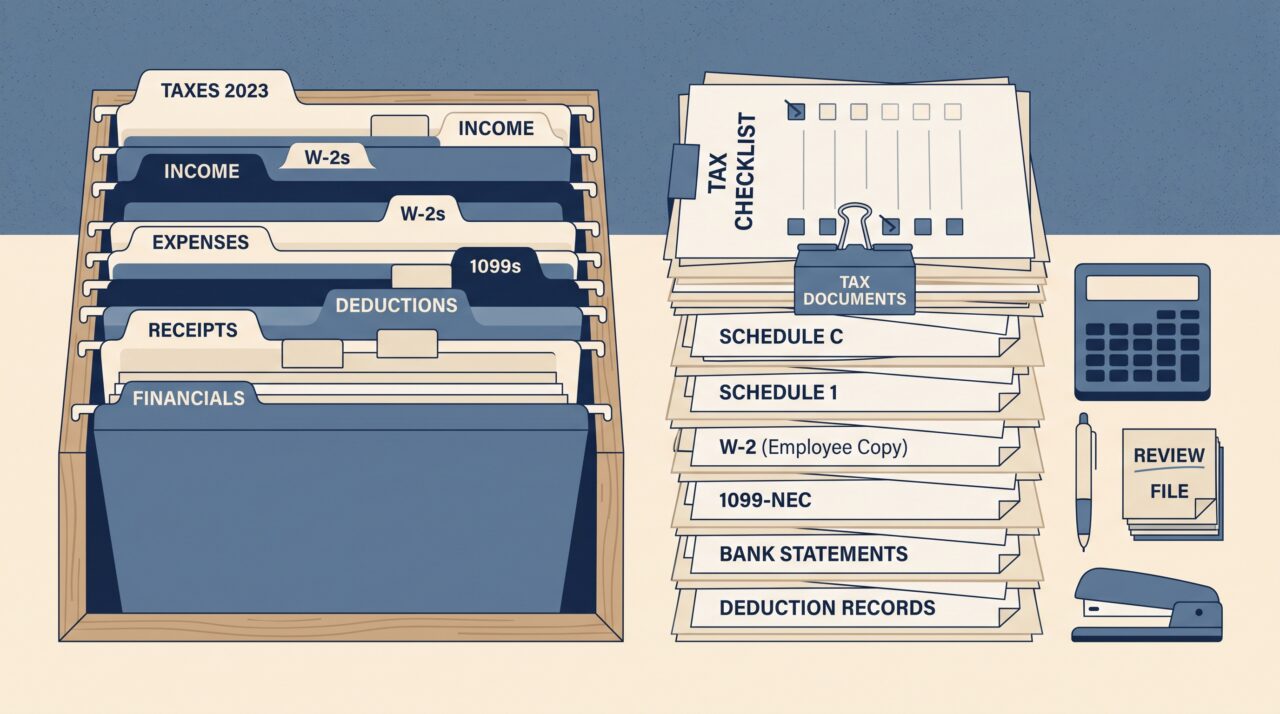
Document Checklist
Here’s the thing – most people wait until their attorney asks for these documents. Don’t. Gather them yourself first, because it puts you in control of your own financial story instead of scrambling to catch up during discovery.
1. Two to three years of tax returns with each schedule, both federal and state – especially Schedule C if you’re self-employed.
2. Twelve months of financial institution and credit score card statements on each account, now just not combined.
3. Retirement account statements for any 401(k), IRA, or pension, along with actual plan files.
4. Every 1099 or pay stub you receive – 1099-NEC, 1099-K, W-2s, whatever applies to your scenario.
5. A running list of goods and debts such as domestic equity, motors, business arrangements, credit score cards, and personal loans.
6. Insurance regulations, which cover health, lifestyle, disability, owners and vehicles.
7. An actual month-to-month finance based primarily on your actual expenses, now not a model of your values that also points to your tax return.
That last one matters more than people expect, especially if you’re self-employed – which brings us to the section most divorce guides skip entirely.
Filing Status and the Numbers That Changed for 2026
Here’s the real question people ask: “What filing status do I even qualify for?” And the answer surprises a lot of people, because the IRS doesn’t care when your divorce process started. It only cares about your marital status on December 31 of that tax year.
| Filing Status | 2026 Standard Deduction | Who Qualifies |
| Married Filing Jointly | $32,200 | Married on Dec. 31, both spouses agree to file together |
| Single | $16,100 | Divorce finalized by Dec. 31, no dependents |
| Married Filing Separately | $16,100 | Married on Dec. 31, filing apart |
| Head of Household | $24,150 | Unmarried, paying more than half of household costs, has a qualifying dependent |
If your divorce won’t be finalized before December 31, you’re still considered married in the eyes of the IRS – even if you’ve been separated all year, even if you haven’t spoken to your spouse in months. You’ll need to file as married filing jointly or married filing separately. This catches a lot of people off guard mid-process, and it can meaningfully change what you owe or what you get back.
If you’re Self-Employed, Your Income Gets a Different Kind of Scrutiny

Self-employed income
This is the part that almost never gets covered, and it’s the one that costs gig workers real money.
Here’s the real question a family court asks: not “what did you report on your Schedule C,” but “how much cash actually came through your hands.” That distinction matters enormously, because legitimate business deductions – mileage, equipment, phone bills, depreciation – can make your taxable income look much lower than the cash you actually had available to live on. Courts know this, and they look past the tax return to figure out your real earning picture.
That cuts both ways. If you’re a self-appointed partner, anticipate your cuts to get surprises – now and again nicely, from time to time no more. If your partner is self-employed, you may need to push for more in-depth to take a look at exactly what their stated benefit reflects.
A Real-World Example
Maria drives for Uber and DoorDash. Her Schedule C showed $28,000 in Internet income last year after mileage deductions, smartphone expenses and car depreciation. However, her actual gross payments from those two systems, as shown on her 1099-K and 1099-NEC paperwork, amounted to $61000 in distributions. During her divorce, her husband’s lawyer asked Uber and DoorDash for stage profit statements immediately instead of relying on her tax return, because the gap between gross payments and internet taxable profits is exactly where disputes appear That her deduction became a legitimate enterprise expense – no longer an attempt to hide cash
The lesson here is not always whatever Maria did wrong. It is that she has turned organized. If you are self-employed and heading towards a divorce, start maintaining your platform of earnings statements, mileage logs, and financial institution deposit information now that you are organized, no longer will the discovery closing date land on your desk.
A few red flags worth watching for, if you suspect your spouse might be underreporting:
- Business income that drops suddenly right before filing, with no clear explanation
- Business expenses that look suspiciously like personal spending — vehicles, meals, travel
- Cash-heavy income, like tips or gig payouts, that doesn’t line up with visible lifestyle spending
Retirement Accounts: Why Skipping the QDRO Is a Costly Mistake
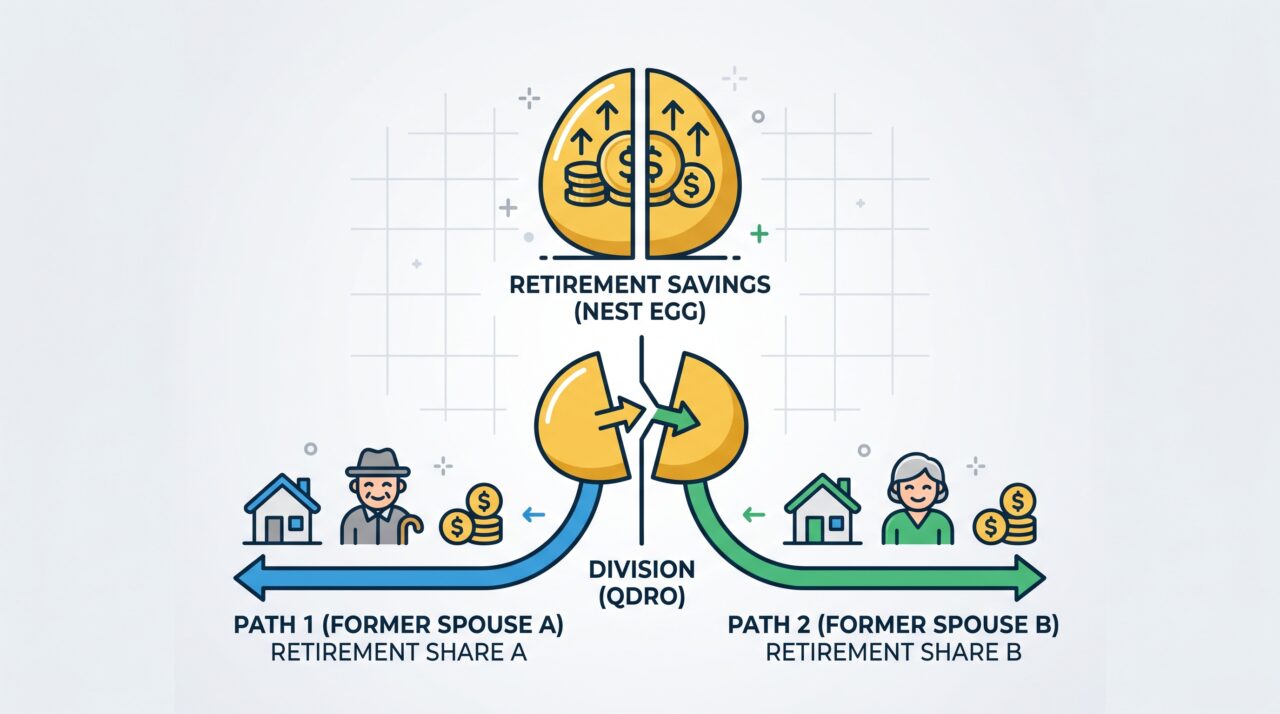
QDROretirement
Let’s guess unmarried are the most high-priced paperwork mistakes humans make in a divorce.
A qualified domestic relations order (QDRO) is a court order that tells a retirement plan administrator the way to split a 401(OK) or pension with an ex-spouse – and it’s the one that allows him to show up without benefit taxes or a 10% early withdrawal penalty for that switch.
Here’s the short version: if your settlement includes any part of a 401(k) or pension, your divorce decree alone is not enough. You need a separate QDRO. Without one, the retirement plan simply won’t split the account, no matter what your settlement paperwork says.
And the cost of skipping this step is real. On a $200,000 retirement account, taking a direct withdrawal instead of using a proper QDRO could trigger roughly $74,000 in combined taxes and penalties. That’s money that disappears – it doesn’t go to either spouse, it just evaporates because of a paperwork shortcut.
IRAs work a little differently. They don’t require a QDRO at all. Instead, they’re divided through what’s called a “transfer incident to divorce,” which moves the funds directly between spouses without triggering taxes, as long as it’s handled correctly.
What to actually do:
- List every retirement account by type – 401(k), pension, traditional IRA, Roth IRA – because the process is different for each one.
- Ask your attorney specifically which accounts require a QDRO.
- File the QDRO paperwork as soon as your settlement is signed. Don’t wait.
- Choose a direct rollover into your own IRA rather than a cash-out, so the funds keep their tax-deferred status.
- Update your beneficiary designations once the divorce is final – this one gets forgotten constantly.
The House: Timing Matters More Than You’d Think

Home Capital Gains
If marital domestic is part of the settlement then maximum humans understand it in addition to the time of sales issues.
Under federal tax rules a filer can often exclude up to $250,000 in capital gains on the sale of a No. 1 home, a married couple presenting to each other up to $500,000 Finalizing your divorce versus selling the residence later can obviously change your tax invoice, so this is absolutely all worth talking directly to a CPA before listing the property.
Is Alimony Taxable in 2026?
The short answer is no – as long as your agreement was signed in 2019 or later. Under those agreements, alimony isn’t deductible for the spouse paying it, and it isn’t taxable income for the spouse receiving it.
This trips people up constantly, because it’s the opposite of how alimony used to work. Before 2019, the payer could deduct it and the recipient had to report it as income. That older rule still applies to agreements signed before 2019 – so if you’re working from a spreadsheet or advice that doesn’t specify which rule applies, double-check the date your agreement was executed before you plan around it.
One small upside worth knowing: if you’re receiving alimony under an older, pre-2019 agreement where it’s still taxable, that income still counts as compensation for IRA contribution purposes – meaning you can still fund an IRA even without traditional earned income.
Common Mistakes That Cost People the Most
- Cashing out a 401(k) to cover legal fees. The IRS treats that withdrawal as ordinary taxable income the year you receive it, even if every dollar went straight to your attorney. It can also push you into a higher tax bracket for the year.
- Assuming the divorce decree alone splits your retirement account. It doesn’t. You need the QDRO, separately.
- Filing as single when you’re technically still married on December 31. This creates an incorrect return that usually has to be amended later.
- Not tracking gig or freelance income separately from personal spending. This is exactly what triggers imputed-income disputes.
- Skipping the CPA because you already hired a divorce attorney. Your attorney handles the legal division of property. A CPA is the one who tells you what that division actually costs you at tax time — and those are two very different jobs.
Conclusion
Divorce is going to be hard no matter how prepared you are. But there’s a real difference between the financial hardship that’s unavoidable and the financial damage that happens purely because a form got filed late or a document never got requested. Almost everything covered in this checklist falls into that second category – preventable, if you know to look for it ahead of time.
If you take one thing away from this, let it be this: don’t wait for your attorney or the discovery process to tell you what your finances look like. Build that picture yourself, first. Pull your bank statements. Know your actual filing status for the year. Figure out, in plain terms, which of your retirement accounts need a QDRO and which don’t. And if you’re self-employed, keep records that show your real cash flow, not just what shows up after deductions – because that gap is exactly where disputes happen, and exactly where you have the power to get ahead of them.
None of this replaces a conversation with a licensed CPA or a family law attorney who knows your state’s rules and your specific situation. But walking into those conversations with your documents organized, your numbers understood, and your blind spots already identified puts you in a fundamentally stronger position – financially and emotionally – for whatever comes next.
FAQs
What financial documents do I need before filing for divorce?
Gather three years of tax returns, 12 months of bank and credit score card statements, retirement account statements, all 1099s or pay stubs, a list of property loan money, and your insurance policies before you document Preparing them speeds up the law and protects you during discovery.
How is 1099 income treated differently than W-2 income in a divorce?
Courts are studying actual cash to be had, not just taxable earnings after deductions. If you are self-employed, obtain forum income statements, mileage logs, and bank deposit records to hold your reported income and not be charged more than it really is.
Do I need a QDRO to split my 401(k) in a divorce?
Yes. A divorce decree by itself will not authorize a 401(okay) or a retirement plan to split pensions. You need a separate qualifying domestic relations order, drafted, accepted through the planning administrator and signed using a judge before any price range can cross any price range to avoid triggering tax.
What’s my filing status if my divorce isn’t final by December 31?
You’re considered married for the entire tax year and need to file as either married filing jointly or married filing separately, even if you were separated or living apart for most of the year.
Do I owe capital gains tax if I sell my house during divorce?
It depends heavily on timing. Selling while still married can preserve a larger capital gains exclusion than selling as a single filer after the divorce is finalized, so this is worth reviewing with a CPA before you list the house.
Should I hire a CPA in addition to a divorce attorney?
Yes, especially if you’re self-employed, hold retirement accounts, or own a home. Your attorney handles the legal division of assets. A CPA verifies what that division actually costs you in taxes — something the legal settlement itself won’t calculate for you.
Can a spouse claim half of a freelance business started during marriage?
Yes, In community property and equal distribution states, any enterprise or party preoccupation released or grown during the marriage is generally controlled as marital property If marital goods or domestic labor supported the business, your spouse is generally entitled to 50% of its assessed value.
How is 1099 contractor income evaluated for spousal support?
Courts compare 1099 contractor profits by reviewing net earnings against gross sales. Judges analyze Form 1040 Schedule C, income and loss statements, and financial institution deposits over a 3 to 5 year window to decide stable, trailing ordinary earnings to factor in legitimate business expenses.






1 thought on “Financial Checklist Before Filing for Divorce in 2026”