
You’ve probably seen the headlines: the government is putting $1,000 into an account for your kid. If you’re a gig worker, freelancer, or hourly earner juggling income that changes month to month, your first thought was probably something like “is this actually real” followed pretty quickly by “okay, what’s the catch.” Trump Accounts Explained for Working Parents: How to Claim Your Kid’s $1,000
Here’s the good news: it’s real, and for most families, claiming it is as simple as checking a box on a tax form. Here’s the part almost nobody explains well: whether you should stop at the free $1,000 or actually keep feeding the account with your own money. Let’s walk through the whole thing.
Quick Answer
A Trump Account is a new type of traditional IRA for kids, created by the One, Big, Beautiful Bill Act on July 4, 2025. Children who are U.S. citizens born between January 1, 2025 and December 31, 2028 qualify for a one-time $1,000 deposit from the federal government. You claim it by filing IRS Form 4547. Contributions of any kind such as that $1,000 could not be made before July 4, 2026.
Key Takeaways
● The $1,000 pilot contribution is real, funded through the U.S. Treasury, and goes to eligible U.S. citizen youth born between January 1, 2025 and December 31, 2028 .
● You declare it by filing IRS Form 4547 the easiest way is to attach it to your tax return, or record it on-line starting in mid-2026
● No money left before July 4, 2026, with $1,000.
● Anyone can contribute up to a blended $5,000 per year; Employers can chip in as good a deal as $2,500 of that tax-free.
● The cash converts to a normal traditional IRA until January 1 of the 12 months your child turns 18 years old.
What Is a Trump Account, Exactly?
A Trump Account is a tax-advantaged traditional IRA that a parent, guardian, or other authorized adult can open on behalf of a child under 18. It came out of the One, Big, Beautiful Bill Act, which President Trump signed into law on July 4, 2025.
Simply put: A Trump account is a traditional IRA set up for the specific benefit of a baby under 18 with a valid Social Security variation. It grows tax-deferred and will become a regular traditional IRA once the child turns 18 years old.
Here’s the thing that trips people up: this is a retirement account, not a college fund. During what the IRS calls the “growth period,” the money has to sit in low-cost funds that track a broad index of mostly U.S. companies think S&P 500 index funds and ETFs, with fees capped at 0.1%. The account belongs to the child, but a responsible adult manages it until the child turns 18.
The first accounts are being managed by BNY, working with Robinhood, though families will be able to roll the balance over to another provider down the road.
Who Qualifies – Including Gig Workers and Self-Employed Parents

Eligibility for the free $1,000 comes down to your child, not your job title or how much you earned last year. If you drive for DoorDash, freelance on Upwork, or work construction jobs on 1099s, you qualify on exactly the same terms as someone with a salaried W-2 job.
Your child qualifies for the $1,000 pilot contribution if they:
- Are a U.S. citizen
- Were born after December 31, 2024, and before January 1, 2029
- Have a valid Social Security number, issued before you make the election
- Are expected to be your qualifying child for the tax year of the election
- Haven’t already had a pilot contribution claimed for them
The most common gig-worker worry has a simple answer: you don’t need to owe federal income tax to get the $1,000. This isn’t a refund or a credit tied to your tax bill – it’s a direct Treasury deposit that gets triggered once you make a valid election.
There’s also a broader rule worth knowing: you can open a Trump Account, without the $1,000, for any child under 18 with a valid SSN, even if they were born before 2025. That child just won’t get the free seed money.
And if your baby was born in 2024, before the cutoff? You can still open a Trump Account for them – it just won’t come with the $1,000, since eligibility for that piece starts with births on or after January 1, 2025.
How to Claim the $1,000: Form 4547, Step by Step
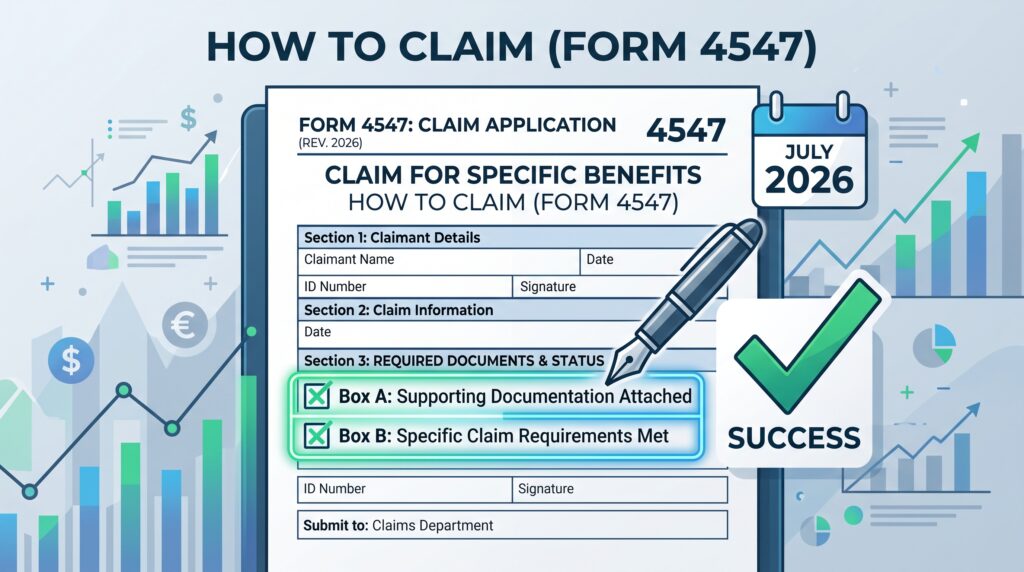
How to Claim the $1,000
You claim $1,000 with the help of submitting IRS Form 4547, formally titled “Trump Account Election(s).” The IRS defines this as a reliable, check-the-field system. Here’s definitely how it works, start completing:
- Confirm your child’s Social Security number. It has to be issued before you file, and the name and SSN must match the Social Security card exactly – mismatches are the number one reason forms get kicked back.
- Get the form. Download it from IRS.gov, or let your tax software (TurboTax, H&R Block, FreeTaxUSA) walk you through it.
- Fill out your section with your information as the authorized adult filing on the child’s behalf.
- Fill out your child’s section and check the box to open the initial account.
- Check the box to elect the $1,000 pilot contribution, but only if your child meets the birth-date and citizenship rules.
- Sign the form. If you’re filing on paper, it needs a real signature a typed one won’t count.
- File it. The fastest way is attaching Form 4547 to your e-filed tax return. You can also mail in a paper copy, or, starting in mid-2026, make the election online at trumpaccounts.gov.
What happens after you file: Treasury (or its agent) starts sending account-activation information in May 2026. Once you authenticate and the account is up and running, Treasury deposits the $1,000 but never before July 4, 2026.
One more thing worth knowing if you’re worried about deadlines: Form 4547 can be filed anytime during your child’s growth period, so there’s no single hard cutoff for claiming the $1,000. That said, filing early means more years for the money to grow, so there’s no real reason to wait.
When Can You Actually Add Your Own Money?
No contributions of any kind yours or the government’s could happen before July 4, 2026. That’s probably the single most-missed fact in coverage of this program.
Once contributions opened, here’s how the limits work:
- $5,000 combined per year from all individual and employer sources, indexed to inflation starting in 2027.
- Employers can contribute up to $2,500 of that total tax-free, as part of a workplace benefit.
- The $1,000 pilot contribution doesn’t count against that $5,000 cap.
- Contributions from qualifying nonprofits and government programs are also excluded from the cap the Michael & Susan Dell Foundation, for example, pledged $250 per child for millions of kids.
Everything you contribute beyond the seed money is after-tax – none of it is tax-deductible.
Is a Trump Account Actually Worth Putting Your Own Money Into?

Trump Account Actually Worth Putting Your Own Money
Claiming the free $1,000 is a no-brainer for almost every eligible family. Whether to add your own money on top is a more nuanced call, and this is where most articles on the topic go quiet.
The upside is tax-deferred growth your investments compound without getting taxed year to year. The catch shows up on the way out. When earnings eventually get withdrawn, they’re taxed as ordinary income rather than at the lower long-term capital gains rate. That’s the exact complaint you’ll see repeated across personal finance forums, and it’s a fair one.
So here’s a reasonable rule of thumb: take the free $1,000, no question. But before you start funneling your own $5,000 a year into it, most families are better served by covering higher-priority buckets first – an emergency fund, your own retirement savings, and often a 529 plan or custodial Roth IRA for your child. Let’s compare those next.
Trump Account vs. 529 Plan vs. Custodial Roth IRA
Each of these accounts is built for a different job, so the “best” one really depends on what you’re saving toward.
| Feature | Trump Account | 529 Plan | Custodial Roth IRA |
| Main purpose | Long-term savings / retirement | Education | Retirement |
| Free $1,000 from the government? | Yes, for eligible kids | No | No |
| Does the child need earned income? | No | No | Yes |
| Annual contribution limit | $5,000 combined | Very high (gift-tax based) | $7,000 (2026)* |
| How it grows | Tax-deferred | Tax-free for qualified use | Tax-free |
| Tax on withdrawn earnings | Ordinary income | Tax-free for education | Tax-free after 59½ |
| Can you touch it before 18? | No, it’s locked | Yes, for education | Contributions can come out |
| Early withdrawal penalty | 10% after age 18 (Sec. 72(t)) | 10% on non-qualified use | 10% on earnings |
The takeaway: for education costs, a 529 usually wins, since qualified withdrawals come out tax-free and up to $35,000 can even roll into a Roth IRA. For a teenager with real earned income from an actual job, a custodial Roth IRA is powerful. The Trump Account really shines for one specific thing – locking in the free $1,000 and adding a retirement bucket once your other priorities are covered. Plenty of families will end up using a 529 and a Trump Account side by side.
How Much Will the $1,000 Actually Grow?
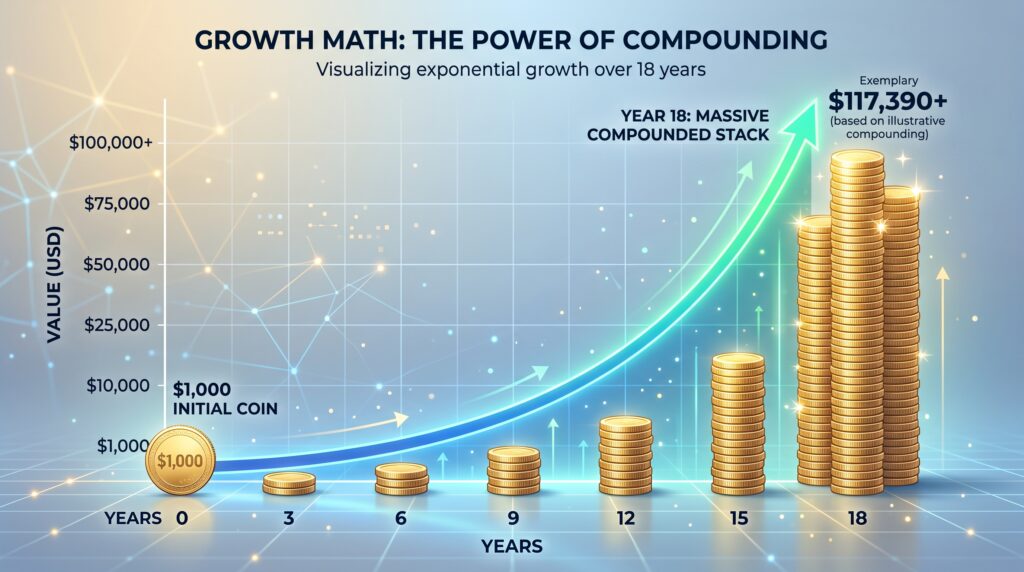
How Much Will the $1,000 Actually Grow
Leaving the 7% normal annuity untouched for 18 years on the go, that single $1,000 deposit grows to roughly $3,380 before additional contributions Here’s the math, so you can run your own numbers:
● Future value = $1,000 × (1.07)^18
● (1.07)^18 ≈ 3.38
● Result: more or less $3,380
Now layer in some modest contributions. If a family adds just $50 a month $600 a year from July 2026 through age 18, at 7%:
- 18 years of $600 a year adds up to about $21,600 contributed
- Growth brings the total to somewhere around $26,000–$27,000
- Add the $3,380 from the seed money, and you’re looking at roughly $30,000 by the time your child turns 18
A quick caveat: 7% is an illustrative average, not a guarantee, and these numbers assume no fees beyond the 0.1% cap and no withdrawals along the way. Actual results will move with the market.
Withdrawal Rules and What Happens at Age 18
During the growth period, the money is essentially locked no withdrawals except in narrow situations, like the death of the child who owns the account. That growth period runs from the day the account opens through December 31 of the year before your child turns 18.
Starting Jan 1, year after your child turns 18, the Trump account turns into a popular traditional IRA, and then regular IRA rules kick in. That approach can lead to a 10% initial distribution penalty before age 59½, unless an exception applies qualified higher training fees or primary home purchases, for example
One helpful exception is really worth flagging: in the 12 months that your baby turns 17, families can roll stability into an ABLE account if the child has a qualifying disability.
Divorced or Co-Parenting? Here’s Who Claims the $1,000
Only the parent who can claim the child as a dependent for that tax year can elect the $1,000 pilot contribution and this matters a lot for separated and divorced families.
Because the election is directly linked to the “anticipated qualified child” fame, any parent claiming a child that the yr is the only one who can record Form 4547 for seed money. A baby can most effectively process a pilot contribution, at any time, so co-parents may want to coordinate ahead of time to avoid replication or rejected declarations.
If your custody settlement is in order every year you claim a child, line up submitting Form 4547 with anyone who claims your passed year structured for $1,000. When uncertain, put the plan in writing and looped it to your CPA or your family-law attorney.
Two Real-World Examples

Sofia, 31, drives for DoorDash and Instacart in Texas.
Sofia’s daughter Emma turned birth in March of 2026. Sofia documents a Schedule C and is concerned that her unusual 1099 earnings could disqualify her it won’t, given that eligibility depends on Sophia, not Sofia ‘s benefits. Sofia attaches Form 4547 to her 2026 return, checking the appropriate boxes, and Emma is in line for $1,000, which is deposited once the account is activated no later than July 4, 2026. Sofia plans to show $25 a month, when coins are allowed to flow. At 7% over 18 years, Sophia’s account should land somewhere around $13,000 – $14,000 – built by a driver who never felt “rich enough” to invest.
James, 44, is a divorced freelance videographer in Ohio.
James co-mom and dad claims his son Eli, born in 2025, is his foundation in turn with his ex-wife. Since only based-claim discretion can make the $1,000 option, they agree in writing that James – who claims Ellie in 2026 – will record a Form 4547 for the seed cash James, a FIRE-minded keeper, already maxes out the Solo 401(k) and 529 plan for Ellie. He treats the Trump account as a bonus: He takes the untied $1,000, yet maintains his contributions flowing into 529 and Roth bills, where the tax treatment of withdrawals works more to his liking.
Common Mistakes to Avoid
- Waiting because you think there’s an April deadline. There isn’t one Form 4547 can be filed anytime during the growth period but waiting still costs you years of compounding.
- Assuming you need to owe taxes to qualify. You don’t. The $1,000 isn’t tied to your tax bill.
- A name or SSN mismatch. Your child’s name and SSN need to match the Social Security card exactly, or the election may not go through.
- Expecting money before July 4, 2026. Nothing moves before that date, including the $1,000.
- Both divorced parents filing for the same child. Only the dependent-claiming parent should elect the $1,000 coordinate first.
- Over-contributing your own money before covering higher priorities, like an emergency fund, your own retirement, or a 529.
- Treating it like a college fund. It’s a retirement account, complete with a 10% early-withdrawal penalty after 18.
Conclusion: What to Do Next
The Trump account is still a token-new program, and the guidelines will potentially hold to get fragile as the IRS finishes rulemaking. But the middle part of that is easy enough to work out today: If you have a baby born between 2025 and 2028, there could be federal cash on the table, and claiming it costs you nothing however form.
For operating parents especially gig people, freelancers, and everybody shredding 1099 benefits together – the biggest risk isn’t the system itself, it’s letting confusion or mistrust get into the type of free cash you’re already entitled to without needing your W-2, massive tax invoices, or financial advisor. You want your baby’s social security range, Form 4547, and a couple of minutes.
Choosing where it gets more personal is approximately your personal wealth. Free $1,000 is worth taking for nothing. Adding your own contributions to the top is a real tradeoff – tax-deferred growth now, ordinary earnings tax later so really keep your emergency fund, your personal retirement, and any education financial savings you already have at 529. There’s no accepted right solution right here, simplest the only that suits your circle of relatives’ real priorities.
Here’s a quick checklist to work with:
● Verify that your baby will wear outfits as starting between January 1, 2025 and December 31, 2028 and is a U. S. Citizen with an SSN.
● Beginning in mid-2026, file Form 4547 with your tax return, on paper, or on line through trumpaccounts.Gov.
● Double check that your child’s name and SSN are correct in the size of their Social Security card.
● Don’t count a deposit before July 4, 2026 – activation emails start going out in May 2026.
● If you are divorced or co-parenting, agree in writing who claims the structured and file for $1,000.
● Once contributions are opened, determine how it makes sense to feature a whole lot of your very own money, after covering.
FAQs
Is the $1,000 Trump account real, or a rip-off?
It’s realistic. A, big, beautiful bill act, signed into law July 4, 2025, created a one-time $1,000 Treasury contribution for qualifying U.S. citizen youth born between 2025 and 2028. The IRS administers this system via Form 4547. You can immediately double-check everything on IRS.Gov and trumpaccounts.Gov.
Are gig workers and self-employed parents eligible?
Yeah. Deservingness comes down to your baby, not your job. As long as your baby is a U.S. citizen born with a valid Social Security amount between 2025 and 2028, and your eligibility is dependent, you’re still in whether or not you’re on a W-2 or have filed a Schedule C.
How do I claim $1,000 for my child?
File IRS Form 4547 the very best direction is to attach it to your tax-go back, though you can also report on paper or, starting in mid-2026, at trump accounts.Gov. Select the box to open the account and the field to select $1,000. The Fund deposits funds after activation of your account, no earlier than July 4, 2026.
Do I want to owe taxes on receiving $1,000?
No. This is not always a tax credit score or a refund. It’s an immediate deposit from the fund, so a dad and mom with very little tax and legal liability can still qualify as long as their child meets the eligibility guidelines.
When can I start including my own cash?
Not before July 4, 2026 – that’s a hard rule. After that date, you and your child’s organization (if relevant) can contribute up to a blended $5,000 a year, with employers able to upload up to $2,500 of that tax-free.
Does the $1,000 $ remember near the 5,000 annual restriction?
No. Federal pilot contributions, in combination with qualified rollovers and eligible nonprofit or government contributions, sit outside the $5,000 limit on private and business enterprise contributions.
When can cash be definitively withdrawn?
Normally not until January 1 of the year your child turns 18. Before that, withdrawals are additionally off limits in unusual circumstances, such as the death of the account owner. Once your child turns 18, the account converts to a normal traditional IRA and ordinary IRA policies take over.
Is a Trump account better than a 529 plan?
They are designed for a specific job. A 529 provides you with tax-relaxed withdrawals for education values, while a Trump account gives you a tax-deferred retirement fashionable increase plus that free $1,000. If college is a concern, 529 usually wins. A lot of houses emerge as uses for each.